Health & Wellness
Back Be Nimble
Use Viniyoga to treat problems in the lower back
Everyone knows someone who swears that yoga healed their aching back. And now even the latest science backs up these claims: A 2005 study published in the Annals of Internal Medicine found that practicing yoga postures was more effective than traditional treatments for chronic lower-back pain.
But wait—be careful. The truth is that depending on your particular back problem, moves that show up in most popular forms of yoga—intense twists, inversions, and even a basic Warrior pose—can actually do damage, especially if performed with improper alignment.
However, Viniyoga—the kind proven beneficial in that back-pain study—can bring relief. This technique is really yoga therapy, in which different postures are prescribed by a Viniyoga teacher. When it comes to the back, carefully chosen sequences can help stabilize hyper-mobile joints, loosen contracted muscles, establish new muscular patterns, and increase circulation, says Gary Kraftsow, founder of the American Viniyoga Institute and designer of the lower-back study.
Viniyoga uses the principle of proprioceptive neuromuscular facilitation (PNF). PNF simply means warming up and contracting a muscle before stretching it. Where other styles are static, Viniyoga emphasizes repetition, moving in and out of postures and gradually building the number of breaths you stay in a pose. As you do the reps, you “focus on the breath, observing how the body opens, taking you deeper without force,” says Robin Rothenberg, a Viniyoga therapist in Issaquah, Washington, who coauthored the protocol for the lower-back study with Kraftsow and was the instructor for the yoga classes participants took. This method allows you to “increase the range of motion slowly and cautiously,” she says.
The following sequences are customized for lower-back pain. (Before you try these routines, make sure your doctor has ruled out a herniated disk, which will require different treatment.) Remember, too, that you don’t need to wait until your back blows up to turn to yoga. If you’re developing a problem area, use the designated exercises that follow to help keep the doctor away.
Although it’s a catch-all term, lower-back pain is often the result of instability around the sacrum, a large, triangular bone made of five fused vertebrae in the lower back, wedged between the two pelvis bones and held together by two joints. Problems are typically caused by stress, too much sitting, and over-arching the lower back, Kraftsow says. The following exercises help stabilize the sacrum. As you repeat the poses, engage the abdomen on the exhale in order to continuously tone your abs—and ultimately support your back.
The Sequence
1. Cat/Cow Variation to Child’s Pose
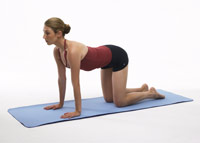
Begin on your hands and knees; shoulders should be directly over the wrists and hips directly over the knees. Inhale and slowly arch your back (Cat), lifting the chest up and away from the belly and extending your tailbone toward the ceiling. On the exhale round the lower back (Cow), gently contracting the belly, then bring the chest down to rest on the thighs (Child’s).
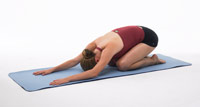
Repeat six times, increasing your range of motion.
2. Airplane Pose
Lie on your stomach with head turned to either side and resting comfortably. Place your palms on the mat alongside your chest with elbows bent, legs together. On the inhale simultaneously lift the head, chest, and legs up off the mat.
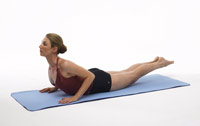
As you do this turn your head back to center. Keeping the legs straight, open them several inches apart.

Exhale, keeping the chest and legs up, and bring the legs back together and squeeze them, inner thigh muscles engaged. Pause and hold for a moment, then return to the starting position. Repeat six times, widening the legs a little more each time.
3. Repeat #1, Cat/Cow Variation to Child’s Pose.