Health & Wellness
Happy Feet, Happy Mind
Take your partner to heaven with this hybrid technique
Thai massage combines assisted yoga poses, ayurvedic medicine, and movement to release tension from the body. The massage giver manipulates “marma” points—vital spots in the body that control a person’s physical and mental health. Where deep tissue massage uses the rubdown to get its desired effects, Thai massage uses movement. “Because our bodies are in constant motion, we take the natural state—motion—and apply it to massage, which we believe makes every sensation be felt deeper,” says Shai Plonski, senior teacher at Lotus Palm in Montreal. Although it sounds exotic, Thai massage requires just a willing partner, a futon or a few blankets, and a little bit of oil.
Plonski recommends massaging the feet because that directly affects "sen lines"—a finite number of energy pathways that originate in the feet and run the length of the body. When you work on the feet, "you are taking the receiver to heaven because stress is easily removed from your body’s extremities,” he says.
Getting Started
Thai yoga massage is not done on an elevated table like traditional massage. Plonski advises using a futon or any kind of mattress on the floor. A yoga mat and a few blankets (four or five) on top of one another also works.
Thai yoga massage doesn’t emphasize use of oils, but there is a place for it. Wash the feet you will work on and apply an oil specific to the receiver’s “dosha” type or constitution. To find a dosha type, take our quick quiz.
Then choose an oil based on dosha:
Vatta: Needs grounding and earthy oils like cinnamon, sesame, and pachouli
Kapha: Needs spice and stimulation such as peppermint, sage, and eucalyptus
Pitta: Needs cooling and calming scents like lavender and sandalwood
Plonski advises massaging the oils into the feet but afterwards drying them off with a towel. “They shouldn’t be greasy or slick. You want to infuse the right oil but then dry the feet off.”
Four Techniques
Sole to Sole or
Sole Walk
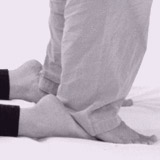
The points on the bottom of the feet, according to reflexology, are connected to different parts of the body. Working the inner heel, for example, affects the lower back.
Receiver:
Lie on belly with one cheek to one side. Elbows bent and the hands in line with the face like a backward "L" (sometimes called Cactus pose).
Giver:
1. Walk on the soles of the receiver’s feet with the balls of your own feet. Imagine yourself doing a walking meditation. Find a rhythm as you shift your body weight slowly from side to side. Gently rub the balls of your feet into the entire arch, ball, and beneath the heel. If the feet are sensitive avoid the pad of the big toe and apply only light pressure.
2. Turn around and repeat the exercise using your heels. The heels apply strong pressure, so begin lightly and get feedback from your receiver on how much weight feels comfortable. Do this until you feel your partner has relaxed, at least 5 minutes using the feet and 5 minutes using the heels.
The next three techniques require the receiver to lie on her back, palms up and legs slightly apart. Just like savasana or Corpse pose.
Gulpha Marma: Promotes Relaxation
The Gulpha marma is the soft indentation on the top of the foot, in line with the third toe, where the foot joins the ankle area. Touching this point the right way can yield extreme relaxation. The giver simply presses a thumb into that point using small circular motions. “I have seen people totally sink into bliss because it creates ripples of relaxation,” Plonski says, adding that “it just doesn’t have the same effect when you do it to yourself.”
Foot Ankle Rotation: Promotes Relaxation

This is simply drawing circles with the feet using the flexibility of the ankles. What you’ll notice is as the leg rotates, the hip sockets rotate and even the shoulders and head begin to follow suit.
The giver kneels with spine straight, the receiver lying before her. The receiver’s leg rests between the giver’s thighs. The giver holds the foot in her left hand, cupping the heel. With her right hand she places the pointer and middle fingers on the top of the foot, near the toes. The giver then gently rotates the ankle clockwise as if drawing circles in the air with the big foot. After 12 or so circles, the giver repeats counterclockwise. Then repeats on the other foot. The ankle joint gets freer with each circular movement.
Foot Spinal Twist: Energizing
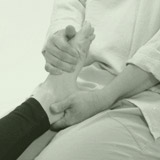
Giver:
With one hand hold the heel while the other hand wraps around the top of your receiver’s foot. Take a firm grip on the instep, twist the foot inward and lean back. Then reverse your hands, wrapping the other hand on the outside of the foot and twist in the opposite direction while you lean back. This can help right the spine, lighten the weight carried by the hips, knees, ankles, and feet, and allow energy to flow more freely from head to toe.