Mind & Spirit
1-Minute Meditation
Four simple techniques to calm your mind
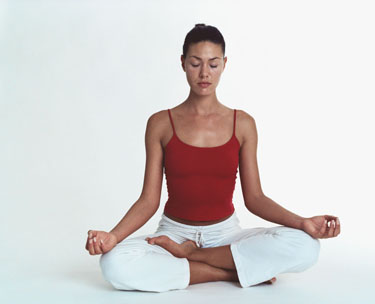
Meditation isn’t just for blessed-out monks in monasteries. The benefits work just as well in the real world, where the laundry needs washing and dinner isn’t even defrosted. When it seems like you need a Red Bull to get in gear, try doing just the opposite. Lower your heart rate with power meditations, quick mental exercises that increase oxygen in the body and calm your nervous system.
Here are four meditation techniques that anyone can do in 60 seconds flat.
Yoga Meditation
If you attend yoga class, keep your meditation in the family. Gyandev McCord, a teacher at The Expanding Light retreat center (expandinglight.org) in Nevada City, California, inherited his 1-minute technique from Paramhansa Yogananda, author of the famous
Autobiography of a Yogi.
Part I: Double-breathe for three or more breaths—inhale for two counts through your nose: a short, sharp inhalation, followed by a long, strong inhalation, completely filling the lungs. Then without pause, exhale through both nose and mouth—again with a short exhalation, then a long exhalation, making the breathy sound “Huh” followed by “Huhhhhhh” while emptying the lungs completely. Tense the entire body as you double inhale, then relax completely as you double exhale.
Part II: Triangular breathing requires you to inhale slowly and smoothly for 4 counts (or 6 or 8 if comfortable) while visualizing that the inhalation is lifting energy up to the brain. Hold for the same count you inhaled for and repeat the mantra AUM (aw-um) silently, once for each count. Then exhale to the same count, feeling that you’re shedding all tension, stress, and restlessness.
Simple Meditation
Stephan Bodian, author of
Meditation for Dummies (stephanbodian.org), is a psychotherapist and spiritual counselor who says that “bringing your thoughts back to yourself” gets you ready to handle tough situations. According to Bodian, the quickest and easiest way to clear your head is to turn your attention from your active thoughts to your sensory experience. Instead of “Will I be late to dinner?” or “Is Suzanne angry at me?” consider questions like “What do I taste, smell, or hear?” Answer those slowly and methodically and not with intellectual analysis.
As your mind relaxes “watch” the breath come and go—either by focusing on your nostrils or on the rise and fall of your belly. Don’t worry if at first you tense up. Many people will instinctively contract muscle and mind as they begin to pay attention to breathing. If that happens start over and release.
Taoist Meditation
Taoist meditation is one of the simplest practices. Susan Rabinowitz, director of the Taoist Arts Center (taoist-arts.com) and a licensed massage therapist, has practiced Taoist technique for over 25 years. Rabinowitz says the major benefit is release of blockages and pain.
Stand or sit still in an upright position, with your feet on the floor. Let your chest and belly relax and let your spine become erect. Feel as if your head is being suspended from above, so your muscles can relax and you will remain tall. Breathe deep and think of the air moving down into the lower part of your lungs so that as you inhale your belly expands like an umbrella opening, and as you exhale your belly collapses like a closed umbrella. Relaxing your diaphragm and your abdomen throughout will help you deepen the breath. The more relaxed you are, the deeper the breath. Once your breath is relaxed, forget about it.
Let your mind become aware of the sensations in your body. Bring your mind to the top of your head and feel whatever you can. When you are ready let your mind drop to your face and relax your eyes, nose, cheeks, and jaw. Continue downward at your own pace, stopping at your neck, chest, belly, tailbone, knees, ankles, feet, and toes. After you relax your toes let your mind continue into the earth until it comes to a rest. Stay there as long as you like and then continue on your day.
Hybrid Meditation
Think of this technique as a cross between Taoist meditation and Buddhist meditation. According to Masahiro Ouchi, who teaches TaoZen meditation at the Healing Tao Center in New York City, Japan, and Europe (taozenlife.com), “TaoZen is a mind-body-spirit discipline that applies Eastern traditions to contemporary life. It is the art of health and happiness.”
This counting meditation is called “Su-Soku,” which means “counting the breath” in Japanese. It’s perfect for when you’re in the ATM line and the guy ahead of you is aiming to set a world record in number of transactions at one kiosk.
First, sit cross-legged on the floor so you are comfortable. (If you can't sit, just try to get comfortable.) Masahiro recommends using a pillow or folded blanket under your sit bones, so that your spine is elongated and the legs relax. Even if it’s just for a minute you should still be comfortable. Don’t scold yourself to “sit up straight.” Your spine isn’t naturally “straight”—it should feel naturally curved and free but extended. The next step is easy—simply smile. Start at the face. Lips softly closed, eyes softly closed. The tongue should be resting on the roof of your mouth. Then relax your shoulders and form a mudra with your hands. Sounds fancy but it’s just resting the back of the hand on the knee and connecting thumbs to index fingers while leaving the other fingers relaxed and open. Become aware of your breathing.
Begin to count. Exhale, inhale: one. Exhale, inhale: two. And so on. Count to 10. Don’t worry if you get lost in the counting or find yourself counting to fourteen; that means you are meditating. If you do three sets of counting to 10, you should have cleared your head. Finally, slowly open your eyes. According to Masahiro, your “third eye” (an energy center at the middle of the forehead) will remain open, allowing you to have more wisdom and perspective in your day.